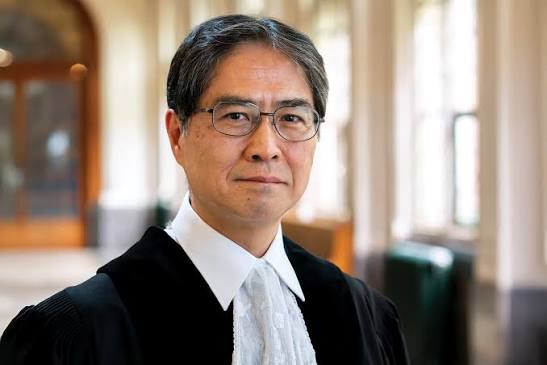
International Court of Justice (ICJ) President
Yuji Iwasawa has said that the court’s caseload remains at a record level, with
24 cases involving disputes between different countries currently under
consideration. He explained that disputes between member states concern a wide
range of legal issues, including land and maritime boundaries, border
demarcation, human rights, economic relations, legal immunity, and the
interpretation and application of treaties covering various subjects.
Briefing the United Nations General Assembly on
the court’s annual report, Iwasawa said that since August 1, 2025, the court
had held hearings in five cases, delivered one judgment concerning
intervention, and issued two advisory opinions. It had also issued one order on
a request for provisional measures and another order concerning the
admissibility of counterclaims. The court is currently conducting detailed
legal examinations of two cases. These include a case brought by Nicaragua
against Germany over alleged violations of certain international obligations
relating to the Occupied Palestinian Territory.
Court Judgments and Advisory Opinions
The ICJ president also provided the General
Assembly with a brief overview of the court’s judgments, advisory opinions and
major orders. One of the advisory opinions concluded that workers’ right to
strike is protected under the 1948 Convention on Freedom of Association and
Protection of the Right to Organise, also known as Convention No. 87.
Yuji Iwasawa also referred to a report he had
prepared last year in connection with an advisory opinion issued by the court
in October. That opinion concerned Israel’s obligations regarding the presence
and activities of the United Nations, other international organisations and
member states in and in relation to the Occupied Palestinian Territory.
Iwasawa also mentioned various events being
organised this year to mark the 80th anniversary of the court’s first session.
On this occasion, he highlighted the alumni association of the Judicial Fellowship
Programme launched by the court. Under this programme, 15 to 16 talented young
law graduates from universities around the world are given the opportunity to
enhance their legal knowledge and professional skills at the court’s
headquarters.
A Path Towards Legal Settlement
Addressing the General Assembly, its President,
Khalilur Rahman, said that amid rising conflicts and declining mutual trust,
the court provides parties with a path away from confrontation and towards
legal settlement through independent and impartial judicial proceedings. He
said the court clarifies rights and obligations, strengthens legal certainty
and gives practical effect to the principle of the sovereign equality of states
before the law.
Yuji Iwasawa outlined three key
priorities for achieving this objective:
- Ensuring that the court isable to operate independently and impartially.
- Matching the responsibilities assigned to the court with the resources available to it.
- Translating obligations under international law into practical action.