Israel has plunged into a political crisis
following the announcement of the final results of its general election, with
neither political bloc securing the majority required to form a government. As
a result, the formation of a new government appears increasingly difficult. According
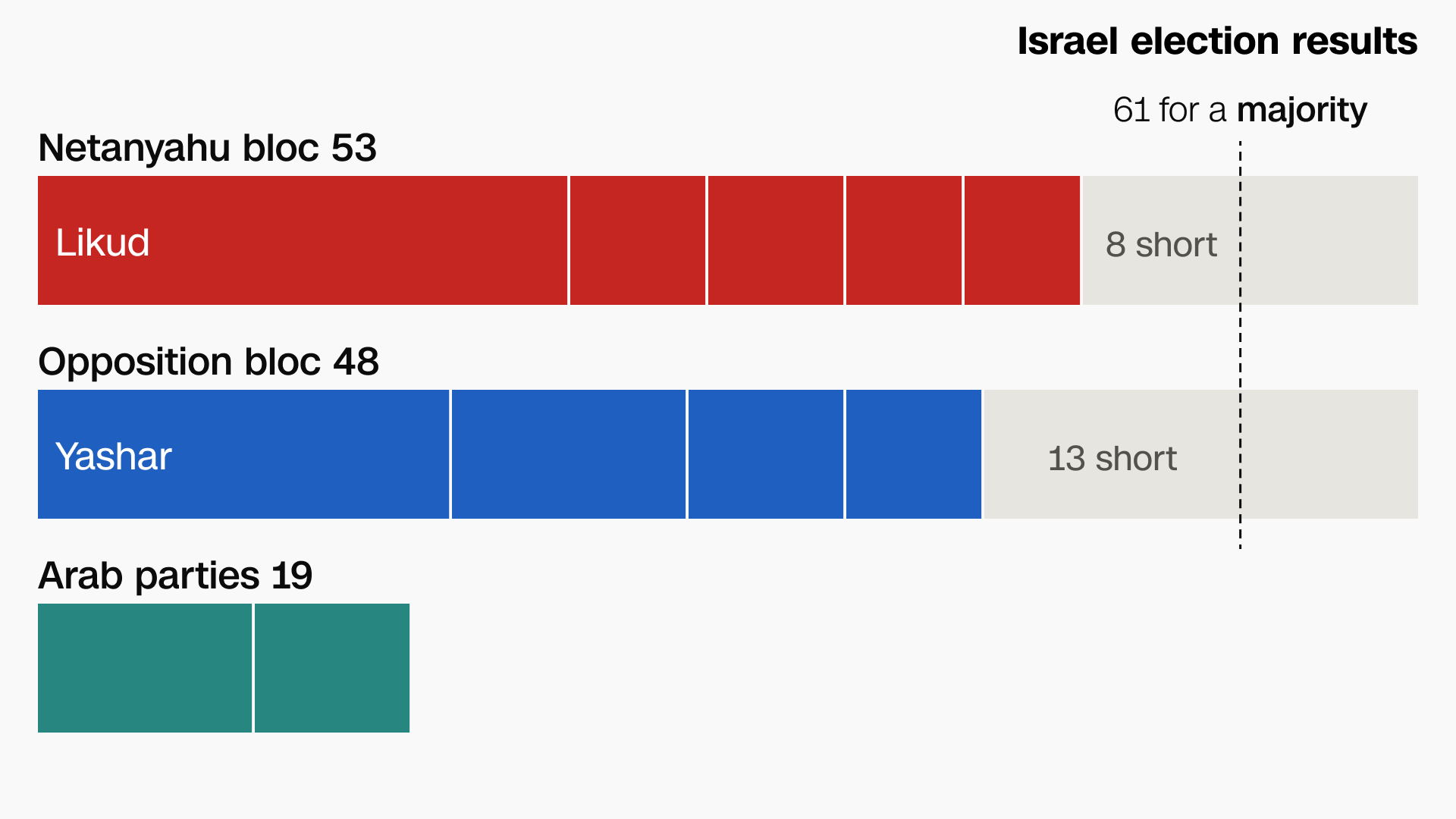
to US broadcaster CNN, a minimum of 61 seats is required to form a government
in Israel’s 120-member parliament, the Knesset. However, neither the right-wing
coalition led by Prime Minister Benjamin Netanyahu’s Likud Party nor the
opposition alliance headed by Gadi Eisenkot’s centrist Yashar Party has managed
to secure the required majority.
Following the election results, Israel could face
weeks or even months of political uncertainty. Ideological differences among
political parties and their reluctance to form alliances with one another are
likely to make the formation of a workable coalition difficult. Nevertheless,
four possible scenarios are being considered to resolve the political deadlock:
an opposition-led government, a national unity government, Netanyahu winning
over lawmakers from opposition parties, and holding another general election.
The first possible option is for opposition
parties to join forces and form a government without Netanyahu. To make this
plan work, the opposition would need to establish cooperation between Jewish
and Arab political parties. However, this is also the biggest obstacle to such
an arrangement. Former Prime Minister Naftali Bennett and former Defence
Minister Avigdor Lieberman, both part of the opposition alliance, oppose any
government formed with the support of Arab parties. Neither leader wants Arab
parties to become part of a governing coalition or provide outside support to a
minority government.
In Israel’s political history, an Arab party has
joined a government as a full coalition partner only once. In 2021, the Arab
party Ra’am joined an eight-party coalition that removed Netanyahu from power.
However, that government collapsed after approximately one year. Even if
opposition parties fail to form a government, they could use their potential
parliamentary majority to bring about changes in key positions. This could
include replacing the Knesset speaker, an attempt that could be used to limit
the powers of Netanyahu’s caretaker government. However, finding a replacement
for Netanyahu as prime minister would remain a major challenge for these
parties.
The second option is the formation of a national
unity government. Under this scenario, the two major political blocs could
abandon their existing arrangements and agree to form a joint government. Such
a government would require Netanyahu’s Likud Party and its current coalition
partners to join at least one opposition party. According to reports, Netanyahu
may be willing to part ways with far-right National Security Minister Itamar
Ben-Gvir. However, he is reluctant to exclude Finance Minister Bezalel Smotrich
and the religious parties from the government.
On the other hand, opposition leader Gadi
Eisenkot has already ruled out the possibility of forming a government with
Netanyahu. If he changes his position, Israeli voters who oppose Netanyahu may
view the move as a retreat from his previous commitments. The third possible
scenario involves Netanyahu attempting to win over lawmakers from opposition
parties. Under this plan, he could try to persuade opposition lawmakers or
individual parliamentarians to join his coalition in order to secure the
majority needed to form a government.
However,
this option is also unlikely to be easy. All four leading opposition figures—Gadi
Eisenkot, Naftali Bennett, Avigdor Lieberman and Yair Golan—have made it clear
that they will not join a government led by Netanyahu. Netanyahu’s current
coalition is eight seats short of the majority required to form a government.
He would therefore need the support of at least eight opposition lawmakers.
Given the firm positions adopted by the political parties, persuading such a
large number of lawmakers to join his side appears difficult.
The fourth and final option is to hold fresh
elections. If political parties fail to form a government through any of the
available arrangements, Israel may have to hold another general election. Israeli
President Isaac Herzog will consult the leaders of political parties elected to
the Knesset. After hearing their views, the president will invite one of the
political leaders to attempt to form a government.
Under Israel’s parliamentary system, the leader
tasked with forming a government is given 28 days to complete the process, with
a possible extension of another 14 days if necessary. If the first candidate
fails, the president can assign the responsibility to another leader, who will
also have 28 days to form a government. If the second attempt is unsuccessful,
a majority of Knesset members can ask the president to give a third candidate
an opportunity. That candidate will have 14 days to form a government. If all
these attempts fail and no party or coalition succeeds in forming a government,
fresh elections will be held.
Under the current circumstances, Netanyahu has an
important political advantage because he can remain in office as caretaker
prime minister until a new government is formed. If Gadi Eisenkot is given the
first opportunity to form a government but fails, Netanyahu could subsequently
be assigned the responsibility. If Netanyahu also fails to secure a majority,
Israel could remain in political deadlock, paving the way for another general
election. In the meantime, Netanyahu would continue serving as caretaker prime
minister until a new government is established.
Following the latest election results, another
election before the spring of next year appears unlikely. However, if political
differences remain unresolved, the possibility could become a reality. If
Israel holds another general election, it would be the country's seventh
general election in the past eight years. Thus, the latest election results
have once again plunged Israel into a prolonged political crisis, leaving the
formation of a new government uncertain.