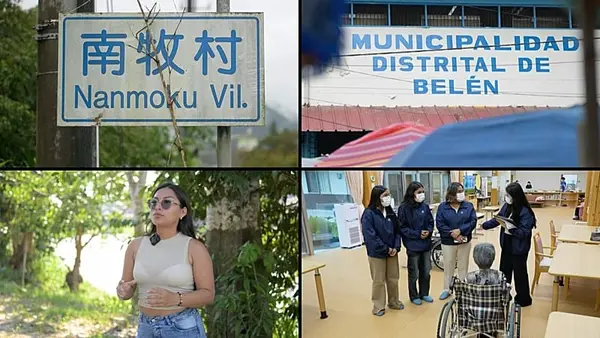
A mountain village in Japan recently gave a warm
welcome to unexpected visitors from Peru, marking the first visit under an
agreement that could allow Peruvians to settle there. According to AFP, the
initiative aims to revive a village inhabited mainly by elderly people and
facing the threat of disappearing.
The mayor of Belén, a city in Peru, and two young
women visited Nanmoku, a village in Japan’s Gunma Prefecture with a population
of just 1,300. When they visited a local nursing home, elderly residents
welcomed them with a mixture of surprise and smiles. Wendy Sangama, a
19-year-old student, told the news agency, “As soon as I arrived here, I fell
in love with everything about this place. This is a village where I could
potentially see myself living in the future.”
A Village at Risk of Disappearing
Nanmoku is one of Japan’s oldest villages, where
more than 70 percent of the population is aged 65 or above. A report published
in 2014 identified it as one of the Japanese villages most at risk of
disappearing. Along the village’s main road beside the Nanmoku River, houses
and shops stand largely deserted, with most closed and the streets often quiet.
Local officials hope that the sister-city agreement with Belén will encourage
young people from the Peruvian city to settle in Nanmoku, although it remains
unclear how they would obtain residency visas.
Peru has a sizeable community of people of
Japanese descent. However, Nanmoku Mayor Saijo Hasegawa said the agreement
resulted less from a deliberate strategy than from an unexpected meeting with a
Japanese-Peruvian businessman. He said the village needed to attract more
residents, including foreigners, to ensure its survival, regardless of where
they came from. Without new residents, he warned, the village could eventually
reach a point where even public transport might have to be discontinued.
A Shortage of Jobs and New Hopes
Despite Japan’s severe labour shortage,
opposition to immigration is growing. Prime Minister Sanae Takaichi has been pushing
for stricter rules concerning foreign nationals. Nanmoku has made several
attempts to attract young people from other parts of Japan, but its mountainous
location means that job opportunities and arable land are extremely limited. Mayor
Hasegawa said around 60 people die in the village each year, while only two or
three babies are born. In contrast, Belén in Peru has a relatively young
population.
The poor neighbourhood of Belén, in the Amazonian
city of Iquitos in northeastern Peru, has an average age of just 27. Home to
more than 60,000 people, the area is sometimes described as the “Venice of
Latin America” and can be reached only by air or boat. Ketsi Yahuarcani, a
23-year-old student who was part of the visiting group, described the
experience as wonderful. “If I get the opportunity to settle here, I will
definitely stay,” she said. Neighbouring districts around Nanmoku have allowed
foreign workers, particularly caregivers, to come to the area. However, they
generally arrive on short-term or technical visas.
Mayor Hasegawa said his vision was different.
Rather than workers who stay for only a few years, he wants people who will
build long-term lives in Nanmoku. However, 34-year-old Yuki Wanibuchi, who
moved to Nanmoku from Kyoto several years ago, said newcomers would face a
number of challenges, including the language barrier. Knowledge of Japanese is
necessary to obtain a driving licence. Hiroshi Ihara, an 87-year-old resident
of the village, said he had watched his community grow older as all three of
his children had moved to major cities in search of work. “Japan’s population
is declining. I think it would be wonderful if people from overseas came here
and helped us,” he said.