Pakistan, Türkiye, Qatar and Indonesia have
signed a landmark four-country agreement to expand cooperation in the defence
industry. Under the agreement, the four countries will collaborate on joint
defence production, advanced military technology, research and development, and
technical military training.
The agreement, named the “Badr Memorandum
of Understanding,” was signed during a ceremony held in Doha, the
capital of Qatar, on Wednesday. Its objective is to combine the defence
industrial capabilities of the four countries and promote joint industrial
projects. Türkiye’s Ministry of National Defence officially confirmed the
signing, stating that the initiative would further strengthen existing defence
ties among the participating countries and create new opportunities for joint
military production. International news agency Reuters and Türkiye’s state-run
Anadolu Agency have also confirmed the agreement.
Khawaja Asif Signs on Behalf of Pakistan
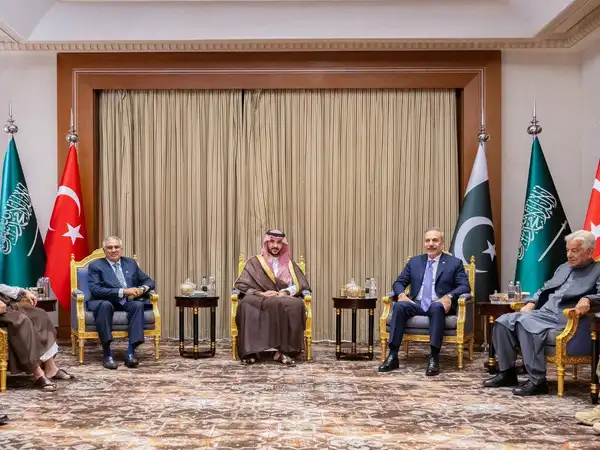
Senior defence officials from all four countries
attend ceremony
According to Turkish media reports, Pakistan was
represented at the signing ceremony in Doha by Federal Minister for Defence
Khawaja Muhammad Asif, while Türkiye’s Defence Minister Yaşar Güler signed the
memorandum on behalf of his country. Qatar was represented by Deputy Prime
Minister and Minister of State for Defence Affairs Sheikh Saud bin Abdulrahman
bin Hassan Al Thani, while Indonesia’s Deputy Defence Minister Yusuf Jauhari
attended on behalf of his country. Haluk Görgün, head of Türkiye’s Defence
Industries Secretariat, was also present at the ceremony. According to
Türkiye’s Ministry of National Defence, the agreement marks an important step
towards promoting long-term partnerships among the four countries and
establishing a more structured framework for cooperation in their defence
industries.
Joint Weapons Production
Cooperation in technology transfer and military
training
Under the agreement, the four countries will
expand cooperation in joint production, research and development, technical
training, and defence technology transfer by leveraging their existing defence
industrial capabilities. Potential areas of collaboration include the joint
manufacturing of specialised defence equipment components, the exchange of
engineering expertise, professional training for specialists, and the
development of new technologies tailored to the requirements of advanced
defence systems.
According to Türkiye’s Ministry of National
Defence, the cooperation is expected not only to increase the military
production capabilities of the participating countries but also to create new
business and investment opportunities in the defence sector. By combining their
respective expertise and resources, the four countries will be able to
undertake projects that might otherwise be more difficult or expensive for any
one country to complete independently.
Why Was the Agreement Named “Badr”?
The four-country agreement has been named “Badr,”
an Arabic word meaning “full moon.” According to Türkiye’s Ministry of National
Defence, the name represents the idea that the defence industrial capabilities
of the four countries complement one another and that cooperation can help
create a stronger and more integrated system. Turkish officials have described
the agreement as significant from both military and economic perspectives,
saying that cooperation among the four countries could increase defence
production, facilitate the development of new technologies, and help meet the
requirements of partner countries.
Pakistan and Türkiye Already Cooperate on
Warship Production
Pakistan and Türkiye already maintain defence
industrial cooperation, with one prominent example being the MILGEM-class
warship program for the Pakistan Navy. According to Türkiye’s defence industry
authorities, the program has helped Pakistan acquire advanced naval platforms
while also improving shipbuilding capabilities at Karachi Shipyard, training
local personnel, and facilitating the transfer of engineering technology. Similarly,
Türkiye and Indonesia are working on several joint defence production projects,
most notably the Kaplan MT medium-weight tank.
The tank was jointly developed by Turkish company
FNSS and Indonesia’s PT Pindad. Production is also taking place in Indonesia
under technology-transfer arrangements. Defence cooperation between Qatar and
Türkiye is also well established. Qatar has acquired various defence systems
from Türkiye, while companies from both countries are involved in joint defence
projects. The new four-country agreement therefore seeks to bring existing
bilateral initiatives into a broader framework of industrial cooperation.
Does the Agreement Also Establish a Four-Country
Military Alliance?
Following the signing of the agreement, an
important question is whether Pakistan, Türkiye, Qatar and Indonesia have
established a formal military alliance. However, according to the details
released by Türkiye’s Ministry of National Defence, the Badr Memorandum of
Understanding primarily concerns defence industry cooperation, joint
production, research and training. No announcement has been made indicating
that an attack on one participating country would automatically be considered
an attack on all four, or that the countries would be obligated to take
military action to defend one another.
It is therefore more accurate to describe the
agreement as a framework for joint defence industrial cooperation rather than a
collective military defence pact. According to Reuters, the agreement comes at
a time when regional tensions in the Middle East are prompting several
countries to strengthen their defence capabilities and increase domestic
production of military equipment.
What Will the Agreement Mean for the Four
Countries?
The four-country partnership could provide
Pakistan with additional opportunities to access advanced technology, expand
local production, and strengthen engineering capabilities through cooperation
with Türkiye and other partners. Türkiye, meanwhile, could extend the reach of
its growing defence industry and export expertise through new joint projects.
Qatar and Indonesia may also benefit from the partnership in ways that align
with their defence requirements and industrial capabilities.
According to Turkish officials, a key objective
of the memorandum is to move beyond the simple buying and selling of defence
equipment towards long-term cooperation in joint research, production, and
supply chains. However, details of the specific weapons, fighter aircraft, warships,
or other defence systems that may be jointly developed or manufactured under
the agreement have not yet been announced.
No final announcement has been made regarding the
overall cost of the projects, investment commitments, or the timeline for the
start of production. The signing of the Badr agreement by the four countries is
being regarded as a significant development in defence industrial cooperation.
Its practical impact will become clearer as specific joint projects are
announced and implemented.