One year has passed since the ceasefire in Gaza
came into effect. The ceasefire agreement, brokered by U.S. President Donald
Trump and Arab allies, raised hopes that the war would come to an end. However,
Israeli attacks continue, and peace remains a distant prospect in the
devastated territory. The agreement halted large-scale military operations,
secured the release of all remaining living Israeli hostages held by Hamas, and
somewhat improved access for humanitarian aid to Gaza. However, key provisions
concerning the disarmament of Hamas, the establishment of a new Palestinian
administration, and the end of Israeli control over more than half of the
territory have yet to be implemented. Reconstruction in the war-ravaged coastal
enclave has also remained virtually nonexistent.
Israel maintains that progress on other issues
depends on the complete disarmament of Hamas. It is worth noting that Hamas is
designated as a terrorist organization by several countries and entities,
including the United States and the European Union. Hamas, for its part, does
not recognize Israel's existence. Hamas and the Trump administration,
meanwhile, argue that these measures should be implemented simultaneously.
Israeli Prime Minister Benjamin Netanyahu hardened his position over the
summer, even opposing his key ally, Trump. Elections are also scheduled to take
place in Israel this month.
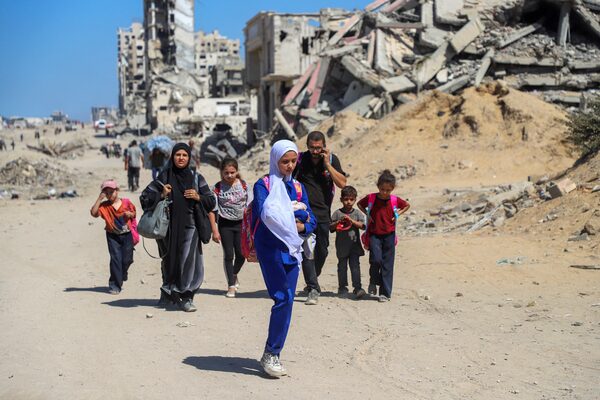
Amid this political deadlock, nearly two million
Palestinians in Gaza continue to live in uncertainty. Most are sheltering in
rodent-infested tent camps, among the rubble of their destroyed neighborhoods,
or inside buildings at risk of collapse. In Jabalia, in northern Gaza, Abdullah
Abu Zubeida and his family are living in a makeshift shelter constructed from
the rubble of their home. He said, “When the ceasefire began last October, we
expected the war to stop, deadly attacks to end, and humanitarian aid to
arrive.” According to him, none of those expectations has been fulfilled.
Nauman Abu Jarad, who moved with his family from Beit Lahia in northern Gaza to
the southern city of Khan Younis, has also found no clear path home as a result
of the ceasefire. He and his family, including five daughters, are still living
in tents.
Hopes Raised by the Agreement, but Promises
Remain Unfulfilled
The 20-point agreement, reached after months of
negotiations under the Biden and Trump administrations, brought an end to
large-scale military operations and secured the return of all remaining Israeli
hostages captured by Hamas during its October 7, 2023, attack. That attack
triggered the current war. The Hamas-led attackers killed approximately 1,200
people and took 251 others hostage that day. Israel responded with extensive
aerial bombardment and ground operations. According to Gaza's Health Ministry,
more than 74,000 Palestinians have been killed since the war began.
The ministry operates under the Hamas-run
administration. United Nations agencies and independent experts generally
consider its casualty records reliable, although the figures do not distinguish
between civilians and combatants. According to the ministry, approximately half
of those killed were women and children. After the ceasefire agreement was
announced, Trump expressed hope for a new era of cooperation in the Middle
East. Speaking at a summit held in connection with the agreement, he said,
“This is a once-in-a-lifetime opportunity to put old rivalries and bitter
hatreds behind us.”
Israeli Control Expands Instead of Withdrawal
Under the agreement, Hamas was supposed to
transfer power to a committee comprising Palestinian administrators, subject to
the approval of the Board of Peace, headed by U.S. President Donald Trump. The
body was tasked with overseeing the implementation of the ceasefire agreement. Hamas
formally dissolved its government in July, but retained its civil servants and
administrative structure. In approximately 40 percent of the Gaza Strip, where
the Israeli military does not exercise control, Hamas remains the most powerful
force. Meanwhile, Israel has prevented the new Palestinian administration from
entering Gaza through Egypt.
The establishment of an international
stabilization force in Gaza was announced in February, but the force has yet to
be formed. Indonesia had pledged to contribute 8,000 troops, but suspended its
plans last spring after international attention shifted elsewhere because of
the war involving Iran. Under the agreement, Israel was supposed to withdraw
its troops from Gaza. Instead, it seized additional territory and pushed the
so-called “Yellow Line” farther west, toward the Mediterranean Sea.
The Israeli military has also continued to
regularly target people accused of violating the ceasefire, approaching the
Yellow Line, or participating in the October 7 attack. Many of those killed in
these strikes have been civilians. According to Gaza’s Health Ministry, more
than 1,400 Palestinians have been killed in Israeli attacks since the ceasefire
took effect. During the same period, five Israeli soldiers were also killed in
intermittent attacks in Gaza.
Disagreements between Trump and Netanyahu
In July, Trump announced an agreement aimed at
disarming Hamas, describing it as a significant breakthrough in a peace process
that had been stalled for a long time. The agreement called for Hamas’s
disarmament to be implemented “gradually, in stages, and within a specified
timeframe,” linking the process to a phased withdrawal of Israeli forces. Hamas
agreed to disarm for the first time, but conditioned its commitment on Israel
halting its attacks and withdrawing its troops from Gaza. A few days later,
Netanyahu announced that Israel would not withdraw from any part of Gaza until
Hamas had been completely disarmed. In doing so, he openly rejected the
agreement announced by Trump.
This unusual disagreement between the two allies
emerged as Netanyahu sought to maintain the support of his nationalist
supporters ahead of Israel’s October 27 election. The election could also mark
the end of his lengthy political career in Israel. Netanyahu faces intense
criticism over security and intelligence failures that preceded the October 7
attack. His opponents accuse him of having been too lenient toward Hamas. In
these circumstances, the scope for even limited compromises over Gaza has
narrowed, at least until a new government is formed, a process that could take
several months. For now, reconstruction in Gaza has barely begun, Hamas remains
in power despite being weakened, and the possibility of a resumption of the war
has not been ruled out.