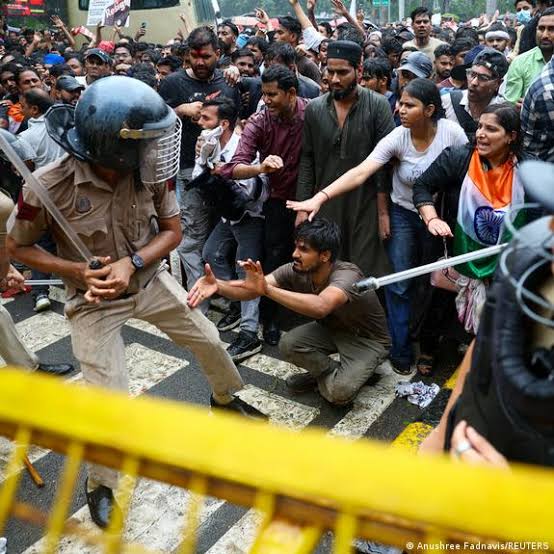
Police launched a large-scale crackdown in the
Indian capital on Saturday to suppress a fierce protest by young people
demanding the resignation of the chief election commissioner, detaining
hundreds of demonstrators. Thousands of security personnel patrolled the
streets, while public transport services and telecommunications were suspended.
The protest, organized under the youth-led ‘Cockroach’ movement, aimed to
mobilize thousands of demonstrators against Chief Election Commissioner Gyanesh
Kumar. Critics accuse him of overseeing changes to voter lists that they allege
could benefit Prime Minister Narendra Modi’s ruling Bharatiya Janata Party
(BJP). Television footage showed police chasing dozens of young protesters
carrying bags through New Delhi’s central business district. The demonstrators
were subsequently bundled into vehicles and taken away. Police denied permission for the protest at
Jantar Mantar, citing security concerns and alleged violations during previous
demonstrations.
According to sources, approximately 500 people
who had arrived in different groups were detained, along with around 50
individuals with criminal backgrounds who were taken into preventive custody.
In a separate statement, police said nearly 200 additional people had been detained
from Connaught Place. Those taken into custody included Abhijit Deepke, founder
of the ‘Cockroach Janta Party,’ other party leaders, and prominent YouTuber
Dhruv Rathee. The operation involved barricades, vehicle searches, drone
surveillance, and temporary detention facilities to prevent protesters from
reaching the designated demonstration site. Amid heightened tensions, stadiums
were converted into temporary holding centers.
For more than three decades, a street in central
New Delhi served as one of the most prominent platforms for Indian citizens to
voice their demands and hold those in power accountable. Trade unions, retired
military personnel, anti-corruption campaigners, women’s rights organizations,
and student leaders regularly gathered outside the historic 18th-century Jantar
Mantar observatory, located near the city’s commercial district and the seat of
political power. However, this week, the country’s best-known platform for
public demonstrations was officially stripped of its designated status as a
protest site. Activists and human rights organizations have expressed serious
concern over what they describe as the shrinking space for democracy. In an
order issued on Monday, Delhi Police stated, “Jantar Mantar’s status as a
designated protest site has been revoked.”
The decision came days after clashes between
authorities and protesters associated with the online anti-government movement
led by the Cockroach Janta Party. The youth-led group has brought thousands of
people onto the streets to oppose changes to voter lists that critics fear
could disenfranchise eligible voters. It is worth recalling that, several
months earlier, the education minister had been forced to resign following
separate protests over irregularities in examinations. Although authorities
have designated three alternative locations for demonstrations in Delhi,
campaigners argue that the right to protest in the world’s largest democracy
depends on remaining visible to the public and being close to lawmakers. Prominent
human rights activist Shabnam Hashmi told AFP, “Jantar Mantar is in the city Centre,
it is connected to all parts of the city, and it is very close to Parliament.
It was an extremely important place for all protest movements. This decision is
nothing but a clear attempt to suppress unwanted voices and dissent.”
In Sanskrit, ‘Jantar Mantar’ means an instrument
for astronomical calculations, designed to observe celestial bodies with the
naked eye. The approximately 1.6-kilometre-long (one-mile-long) street
adjoining the observatory became a focal point for protests after being
designated as a demonstration site in 1993. In July this year, thousands of
students led by the ‘Cockroach’ movement gathered there to protest
irregularities in competitive examinations and attempted to march towards
Parliament. For nearly a month, Jantar Mantar remained a vibrant Centre of
youth-led protests, with its walls covered in angry slogans, rebellious
messages, and graffiti challenging the government. Tensions flared again this
month after police refused to allow the Cockroach Party to hold a demonstration
at Jantar Mantar demanding the chief election commissioner’s resignation over
the controversial changes to voter lists.
On Wednesday, two key leaders of the CJP, who had
jumped over barricades a day earlier in an attempt to “reclaim Jantar Mantar,”
were reportedly sent to jail for five days on charges of crossing a restricted
area without permission. Before being detained, party founder Abhijit Deepke
said, “Jantar Mantar is not merely a geographical location; it represents a
spirit of resistance that no one can ever extinguish.” On Tuesday, Delhi Police
defended its decision by citing a Supreme Court directive requiring authorities
to “identify and designate suitable alternative sites” for protests. These
developments have reignited the debate over where citizens can now go to voice
their grievances and demands. Hashmi said restrictions on the space and timing
of demonstrations at Jantar Mantar had already tightened in recent years.
Nevertheless, its location had made it uniquely effective, allowing protesters
to reach Parliament, government ministries, and media offices with relative
ease.
“In a democracy, you need places where people can
protest. This decision is completely unacceptable,” she said. Authorities say
demonstrations can be held at two locations on the outskirts of the capital,
while a third site, Ramlila Maidan, near the city centre, will remain available
for large gatherings. However, human rights activists argue that moving protests
away from the city centre risks reducing public participation and media
attention, particularly for demonstrators travelling from distant states.
Higher travel costs, longer journeys, and reduced media coverage could diminish
the impact of demonstrations. On Tuesday, one protester told AFP that
demonstrators would continue gathering at Jantar Mantar despite the police
order. Before being detained by police, the protester said, “We will engage in
civil disobedience with full determination. We will sit here and protest.”