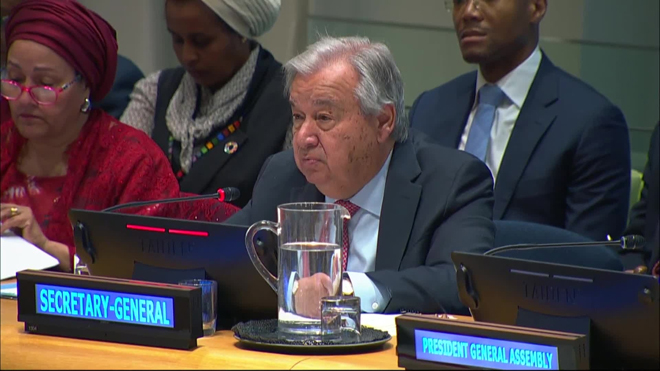
United Nations Secretary-General António Guterres
has said that the need for the global organization is greater than ever amid
the growing impacts of climate change, the artificial intelligence revolution,
wars and spreading hunger. Presenting the UN’s proposed programme budget of
$3.3 billion for next year, Guterres said the organization was facing an
extraordinary range of challenges. Geopolitical divisions are deepening, armed
conflicts continue in various regions, humanitarian needs are rising sharply,
international law is being violated, the climate crisis is affecting every
continent, and artificial intelligence is reshaping economies and societies. Achieving
the Sustainable Development Goals, which aim to ensure that no one is left
behind, is becoming increasingly difficult. In an era of uncertainty and
growing divisions, the need for and importance of the United Nations have
increased, he said.
Progress Under the ‘UN80’ Initiative
The Secretary-General was addressing the Fifth
Committee of the UN General Assembly in New York, which oversees the
organization’s administrative and budgetary affairs. He reminded the committee
that more than a year had passed since the launch of the “UN80” initiative,
aimed at reforming the United Nations’ institutional structure. The
far-reaching reform process seeks to make the Secretariat more efficient,
effective and better equipped to meet the needs of a rapidly changing world. Reviewing
progress under the initiative, Guterres said the Secretariat had moved beyond
merely proposing changes and had begun implementing them. Key achievements
include:
- ·
The number of
underrepresented member states decreased from 28 to 26 between August 2024 and
August 2026.
- ·
Gender parity has been
achieved among internationally recruited staff.
- ·
Payroll operations have
been consolidated.
- ·
The first phase of shared
administrative platforms has been launched in New York and Bangkok.
- ·
Certain functions and
responsibilities of UN departments have been relocated to offices in lower-cost
locations.
- ·
The Secretariat has
absorbed a reduction of 3,116 posts from positions authorized under the regular
budget into its administrative structure.
The Secretary-General said the impact on
employees had been considerably smaller than anticipated, owing to voluntary
early departures and the reassignment of staff to other responsibilities. This
was largely because planning had begun a year and a half earlier in
anticipation of expected financial constraints.
Next Phase of Reforms
Guterres proposed relocating additional positions
and responsibilities across 12 UN entities in 2027. Most of these relocations
are proposed to take place in Nairobi, the capital of Kenya. He also proposed
eliminating certain senior-level positions, downgrading 14 senior posts and
expanding shared administrative platforms to Geneva, Nairobi, Vienna and Addis
Ababa. The Secretary-General noted that, for the first time, the proposed
budget had incorporated anticipated changes into its expenditure estimates from
the outset.
Concerns Over a Financial Crisis
António Guterres warned that cost-cutting and
improvements in administrative efficiency alone would not be enough to prevent
the organization’s financial foundations from becoming unstable. Member states
must fulfil their financial obligations under the UN Charter and make their
payments on time, he said. The organization needs stable and predictable
financial resources to effectively carry out the responsibilities approved by
its own member states.