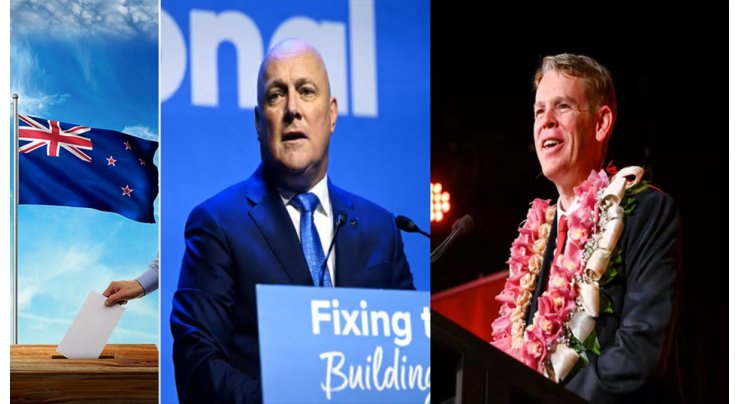
Wellington: The conservative
coalition led by Prime Minister Christopher Luxon has secured a narrow lead in
the preliminary results of New Zealand’s general election. However, the final
allocation of seats needed to secure a clear parliamentary majority will depend
on the counting of special votes. The possibility of negotiations among
political parties to form the next government has also increased. According to
preliminary results, the governing coalition comprising the National Party, ACT
New Zealand and New Zealand First is projected to win a combined 67 seats in
the 131-member Parliament, just above the 66 seats required to form a
government. Meanwhile, the Labour Party, led by former Prime Minister Chris
Hipkins, and its allies have secured a combined 57 seats. However, the election
results are not yet final, with approximately 400,000 special votes still to be
counted.
An interesting aspect of the election is that
while the National Party has secured more parliamentary seats, Labour has
received a slightly higher share of the popular vote. Preliminary figures show
that the National Party secured 29.21 per cent of the vote, compared with 29.36
per cent for Labour. Despite this, the National Party won 42 seats, while
Labour secured 36. Among the other parties, the Green Party won 16 seats, ACT
New Zealand 13, New Zealand First 12, the Opportunity Party seven and the Māori
Party five. The Opportunity Party’s entry into Parliament has been described as
a significant development. The party secured seven seats after receiving 5.96
per cent of the vote. Its leader, David Seymour, has expressed willingness to
hold talks with both major political blocs over government formation. However,
Prime Minister Christopher Luxon has ruled out the possibility of forming a
governing coalition with the party. Political analysts say that if the current governing
coalition loses its majority after the special votes are counted, the support
of smaller parties could play a crucial role in determining the next
government.
Under New Zealand’s electoral system, special
votes cast by citizens living overseas, voters outside their designated
electorates and other eligible individuals are counted separately. According to
the Electoral Commission, approximately 399,365 special votes remain to be
counted, accounting for around 14 per cent of the total votes cast. These votes
have influenced the distribution of parliamentary seats in previous elections
as well. The Electoral Commission has announced that the final results will be
released on November 27. Therefore, the victory of any political party or
coalition cannot yet be considered final. During the election campaign,
inflation, unemployment, the rising cost of living and the national economy
remained major political issues. Support for smaller parties among voters has
further highlighted the political fragmentation within Parliament. To return to
power, Prime Minister Christopher Luxon will need to renew political agreements
with his current coalition partners, ACT New Zealand and New Zealand First.
Meanwhile, the Labour Party will also assess its
chances of forming a government after the special vote results are announced. Approximately
74.6 per cent of registered voters in New Zealand cast their ballots, compared
with a turnout of 78.2 per cent in the 2023 election. Following the
announcement of the final results, political parties are expected to begin
negotiations to form the next government. Until then, the incumbent government
will continue handling routine administrative affairs in a caretaker capacity.