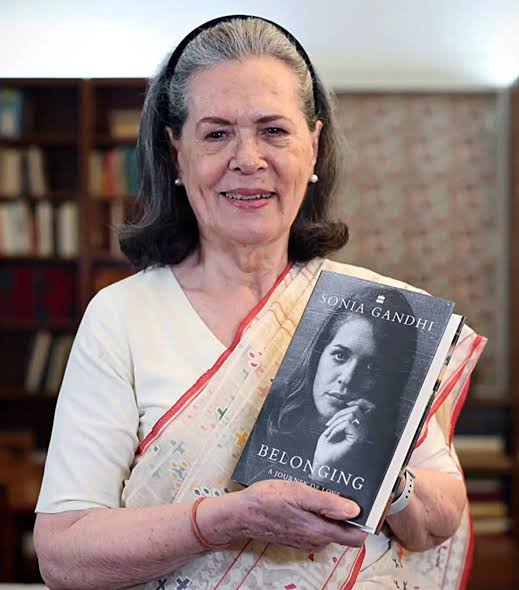
India’s ruling Bharatiya Janata Party (BJP) has
accused opposition leader Sonia Gandhi of covering up the Congress party’s
historical mistakes in her book, Belonging: A Journey of Love, opening
a new front between the two sides ahead of crucial state elections. Congress
leaders have responded by accusing Prime Minister Narendra Modi’s BJP of
turning the book into a spectacle and attempting to politicise it. Released on
Tuesday under the title Belonging, the memoir traces the journey of
the Italian-born Gandhi from her student days in England to meeting her
husband, Rajiv, heir to the Nehru-Gandhi family, and becoming part of India’s
most powerful political dynasty, which has produced three prime ministers. The
79-year-old Gandhi declined the post of prime minister herself in 2004.
However, her family continues to control the Congress party, which has governed
India for a total of approximately 55 years since the country gained
independence from British colonial rule in 1947.
BJP’s Allegations
BJP spokesperson C. R. Kesavan said in a video
statement that Sonia Gandhi could have titled her memoir Whitewashing
instead of Belonging. He said the book appeared intended to sugar-coat
the historical mistakes made by the Nehru-Gandhi family and conceal the major
wrongdoings of the Congress party. Kesavan referred to the 1984 anti-Sikh
riots, which erupted following the assassination of then Prime Minister Indira
Gandhi, Sonia’s mother-in-law, by her Sikh bodyguards. Approximately 3,000
people were killed. Human rights activists accuse the Congress party of turning
a blind eye to the violence and say that some party leaders helped organize the
massacre.
‘The Book Is a Personal Memoir’
In her book, Sonia describes the riots as “a
tragic and shameful chapter”, accusing some officials of turning a blind eye to
the violence or even encouraging it. She also defends her husband Rajiv Gandhi
against allegations of complicity. However, she acknowledges failures of
governance and delays in delivering justice. It is worth recalling that Rajiv
Gandhi became prime minister after the assassination of his mother, Indira
Gandhi. Kesavan also accused Sonia of attempting to normalise and justify the
infamous Emergency imposed by Indira Gandhi. The 21-month Emergency, declared
in 1975, involved the suspension of civil liberties, censorship of the press and
imprisonment of opposition leaders. It remains one of the most controversial
periods in Indian history. Sonia writes that, before imposing the Emergency,
Indira was increasingly isolated and politically cornered. She says Indira was
never entirely comfortable with the decision but felt compelled to continue it
amid political turmoil. Although Sonia has not personally responded to these
allegations, she states in the book’s foreword that it is a personal memoir in
which politics serves as the background and a kind of framework. A Congress
spokesperson did not respond to a Reuters request for comment from Sonia.
Book Tops Amazon India’s Bestseller List
The book has been released at a time when the
Congress party is leading a campaign against the Modi government over a
controversial revision of voter lists, with Sonia’s son, Rahul Gandhi, at the
forefront. Street protests have emerged as the government’s most serious
political challenge since Modi came to power in 2014. They are taking place
ahead of crucial state elections scheduled for early next year in Uttar Pradesh
and Punjab, a Sikh-majority state. The book has dominated discussions on social
media, with posts praising and criticizing it appearing in almost equal
measure, reflecting the country’s political divisions. Newspapers have also
given it extensive coverage, with many publishing excerpts concerning major
events of the past half-century. HarperCollins India agreed to publish the book
after talks between Sonia’s team and Penguin Random House India broke down. The
publisher did not respond to a Reuters request for comment on the book’s
reception. On Wednesday, the book remained at the top of Amazon India’s
bestseller list, despite its price of 1,299 rupees ($14), which was considered
expensive.