Washington, Tehran: The United
States has increased its military preparations for a possible new operation
against Iran. According to a U.S. media report, large quantities of advanced
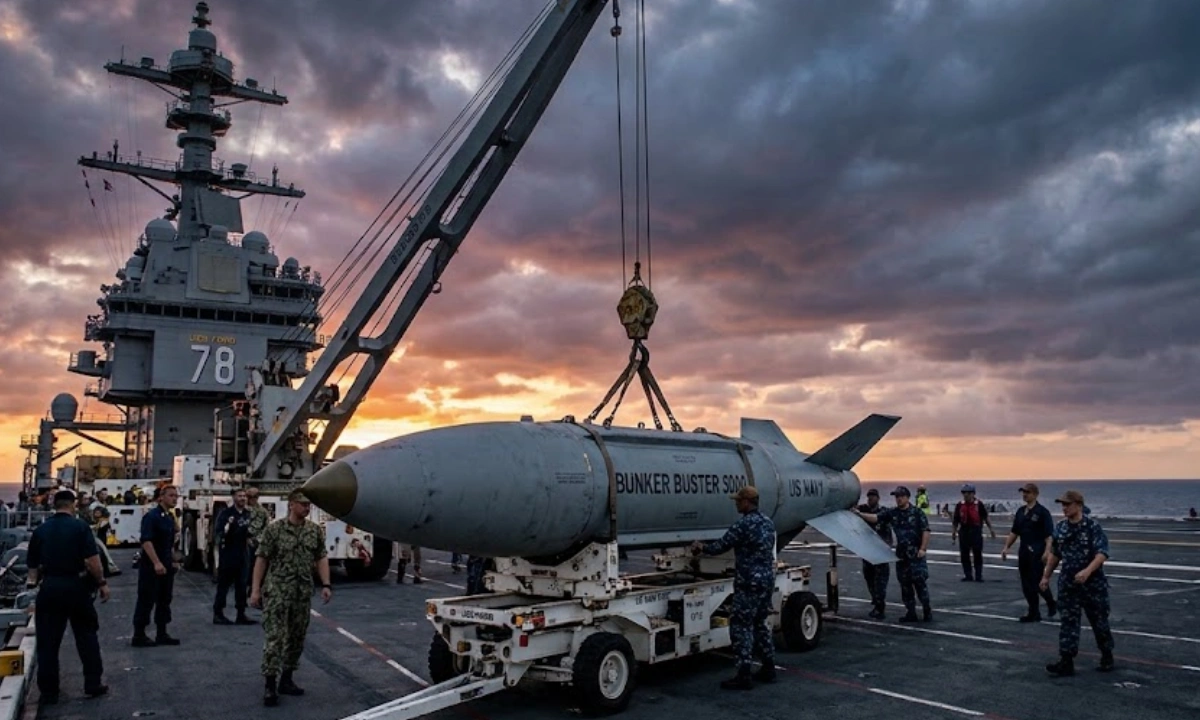
weapons, including bunker-buster bombs, are being transferred to the aircraft
carrier USS George Washington, currently operating in the Arabian Sea.
According to The Wall Street Journal, personnel aboard the U.S.
warship are loading large quantities of standoff land-attack missiles and
specialized bombs designed to strike underground facilities.
The report states that newspaper reporter Shelby
Holliday observed large stockpiles of ammunition during a visit to the aircraft
carrier. According to U.S. officials, the military is strengthening its
position in preparation for a possible operation against Iran. The weapons
being transferred to the vessel are reportedly capable of targeting Iran’s
underground nuclear facilities and fortified military infrastructure.
Bunker-buster bombs are designed to penetrate thick concrete and rock to damage
underground targets.
The development comes amid reports of rising
tensions in the Middle East and the Gulf region. Missile attacks, concerns
about maritime security in the Strait of Hormuz, and warnings about potential
threats to U.S. personnel have further heightened sensitivities in the region.
The report also mentions U.S. President Donald Trump’s policy of avoiding
military action before the midterm elections. However, the transfer of weapons
to the warship has raised questions about whether Washington is preparing for a
new operation against Iran. U.S. officials have not confirmed a final decision
or timeline for any potential action.
Meanwhile, Ali Abdollahi, chief of staff of
Iran’s Armed Forces, has warned that U.S. warships will not be allowed to re-enter
the Persian Gulf. The Iranian military chief said President Donald Trump’s hope
that U.S. forces and naval vessels could return to the Persian Gulf was merely
a dream. In a strongly worded statement, he said the U.S. president would never
see that dream come true. Abdollahi added that Iran would not permit American
military vessels to enter the Persian Gulf under any circumstances or at any
time. A day earlier, the commander of the Iranian Revolutionary Guard Corps
Navy had claimed that U.S. forces had moved 600 to 700 kilometers away from the
Strait of Hormuz.
U.S. President Donald Trump, meanwhile, has
accused Iran of spreading allegedly fabricated reports about explosions
involving naval mines and attacks on ships in the Strait of Hormuz. According
to Trump, Iran is attempting to drive up oil prices ahead of the midterm
elections in the United States. The president has also claimed that more oil is
now passing through the Strait of Hormuz than before the war. He said Iran was
taking various measures to push oil prices higher. Following the latest
statements from Washington and Tehran, attention has focused on maritime
activity and oil shipments in the Persian Gulf and the Strait of Hormuz.
U.S.-Iran Tensions Raise Fears of a Wider
Regional Conflict
The growing military tensions between Iran and
the United States have once again triggered serious concerns across the Middle
East and internationally. In a recent interview, U.S. Ambassador Tom Barrack
did not rule out the possibility of American military action against Iran by
the end of the week. Although the Trump administration continues to offer
negotiations, Barrack made clear that the consequences would be severe if Iran
continued to pose a threat to the United States and its allies. Analysts say
the statement is significant because the possibility of military action before
the congressional elections had previously been dismissed.
Analysts say the central issues in the current
confrontation are Iran’s nuclear program and regional security. Barrack said Washington
was not seeking regime change in Tehran but wanted a balance that could help
end regional instability, hostage-related problems and threats. Israel,
however, has a somewhat different position and seeks to remove Iran’s current
leadership.
Recent developments in the Strait of Hormuz have
further complicated the situation. Following claims that oil tankers belonging
to Iran’s Islamic Revolutionary Guard Corps had been damaged, international
crude oil prices reportedly rose to $117 per barrel. President Trump has
accused Iran of deliberately driving up oil prices by creating risks along
maritime routes. The crisis could also have significant consequences for
Pakistan and other countries. Rising fuel prices on international markets could
increase Pakistan’s import bill and put additional pressure on the Pakistani
rupee.
Saudi Arabia has meanwhile increased oil
shipments through its pipelines in response to the situation, seeking to
maintain global supplies. Diplomatic efforts in Istanbul are currently drawing
international attention. Foreign ministers from various countries have warned
that any confrontation between Iran and the United States could have
devastating consequences for global trade and energy supplies. Observers say
the coming days could prove crucial for international politics and the global
economy.