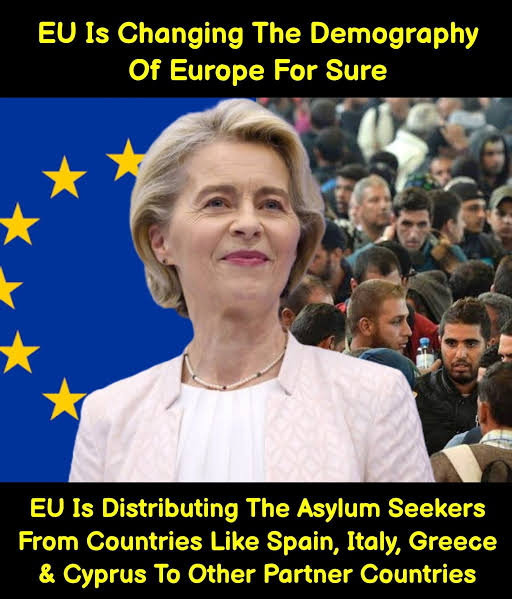
The European Commission, the European Union's
executive body, has designated four key southern Mediterranean countries —
Spain, Italy, Greece and Cyprus — as countries under the greatest migratory
pressure due to unusually high arrivals of migrants. According to the European
Commission's latest assessment report, issued on November 6, under the new EU
Migration Pact, these four countries will be granted the legal right and
facility from 2027 to transfer a specified number of asylum applications and
migrants to other EU member states without obstruction. The Commission made it
clear that although administrative infrastructure in these countries has been
expanded, the influx of asylum seekers remains disproportionately high in
relation to their populations and geographical capacities.
Italy has been identified as particularly
deserving of special relief because of the large number of migrants rescued
from its maritime borders. Spain has also been included due to the impact of
the sudden arrival of thousands of people through Ceuta, a Spanish territory
bordering Morocco, in late July. Alongside this special decision, the European
Commission's report also revealed encouraging developments across the
continent, with irregular migration showing a clear and sustained decline. During
the first half of 2026, irregular crossings at the EU's external borders fell
by more than one-third, continuing a downward trend that has seen a decline of
more than 50 per cent over the past two years. New asylum applications within
the European Union and secondary movements of migrants from one Schengen
country to another have also decreased, while the return of people residing in
the EU without legal authorisation to their countries of origin has
accelerated.
Commenting on the report, European Commissioner
for Home Affairs and Migration Magnus Brunner said that recent immigration
reforms were producing tangible results and that the EU had gained greater
control over who could enter Europe, who had the legal right to stay and who
needed to be sent back. To implement the new system, the European Union has
established a formal framework known as the "Solidarity Pool", in
which participation by all member states, except the four southern countries
facing the greatest migratory pressure, has been made mandatory. Under the
arrangement, other EU countries will have the option of either accepting or
resettling asylum seekers relocated from the southern frontline states,
providing financial assistance of €20,000 for each rejected asylum seeker, or
offering practical logistical support to frontline countries in the form of
border management assistance and technical resources.
The final quotas for the 2027 Solidarity Pool
have been kept confidential pending consultations among member-state
governments. However, Hungary and Slovakia have firmly refused to participate
in the mechanism, creating additional political challenges for the EU's
solidarity system. The agreement also addresses complex migration challenges
along eastern European borders, in addition to the southern maritime frontiers.
The Commission has identified 15 other countries, including Germany, France,
Poland and the Baltic states of Estonia, Latvia and Lithuania, as being at risk
of increased migration pressure. These countries are also dealing with the arrival
of Ukrainian refugees and internal displacement.
Particular criticism has been directed at Russia
and Belarus over what the Commission describes as the use of hybrid warfare
tactics, involving the movement of migrants from the Middle East and Africa towards
European borders as a means of political pressure. These developments have
forced Latvia and Poland to construct border fences and establish buffer zones.
Meanwhile, six countries — Bulgaria, Czechia, Austria, Poland, Croatia and
Estonia — have also been granted special permission to seek partial or full
exemptions from their financial or operational obligations for 2027. The
provision is based on the substantial refugee pressure they have experienced
over the past five years and is intended to ensure a more balanced and
equitable distribution of responsibilities across Europe.