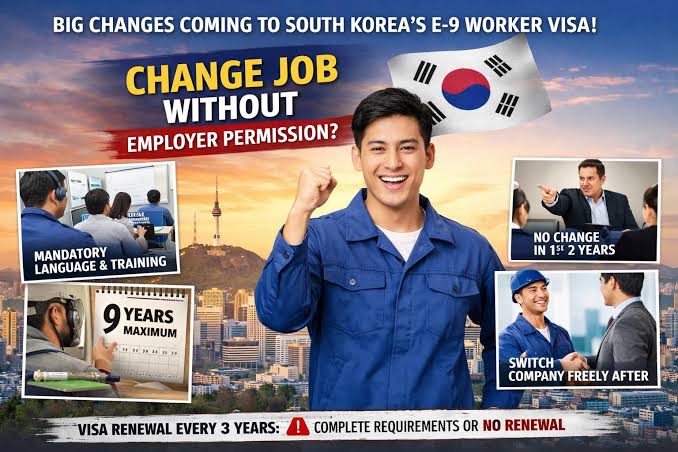
When a new worker considers moving to South Korea
and eventually settling there permanently, the journey usually begins with an
E-9 visa, known as the Non-Professional Employment Visa. If you are still in
your home country, you generally cannot travel directly to South Korea on a
skilled-worker or residence visa. Instead, the official route is through the
Employment Permit System (EPS).
For example, suppose a young man named Ahmed
lives in Pakistan and wants to move to South Korea. His first step is to pass
the basic Korean language examination (EPS-TOPIK) and the skills test with good
scores in his home country. Once he passes these stages, his name is entered
into the official Korean job roster, from which Korean factories and farms
select workers.
After receiving a job contract, Ahmed is granted
an E-9 visa, allowing him to travel to South Korea and begin working in a
manufacturing factory or the agricultural sector. Initially, the E-9 visa
allows him to stay for three years. With the employer's consent, this period
can be extended by one year and ten months, giving Ahmed a total of four years
and ten months to work legally in South Korea. The most important aspect of
this first stage is that, alongside working hard, the employee must improve his
Korean language skills and avoid any legal violations to prepare himself for
the next stage.
Stage 2: Switching from an E-9 to an E-7-4
Skilled Worker Visa
After working legally in South Korea for four
consecutive years, a worker may become eligible to convert an E-9 visa into an
E-7-4 visa, known as the Skilled Worker Visa. This visa operates through a
points-based system. For example, when Ahmed completes four years at his
factory, only a few months may remain on his E-9 visa. Normally, workers have
to return to their home countries when their permitted stay expires. However,
if Ahmed has passed the Korean Immigration and Integration Program (KIIP) or
the Test of Proficiency in Korean (TOPIK), achieving Level 3 or 4, earns an
annual salary of approximately 26 million to 30 million won or more, and
receives a recommendation letter from his factory owner confirming satisfaction
with his performance, he may accumulate the required points.
The points system considers factors such as age,
salary, education and additional points for loyalty to the same employer. Once
Ahmed submits his application and immigration authorities approve his E-7-4
visa, the risk of having to return to his home country when his E-9 visa
expires is significantly reduced. His visa can be renewed from within South
Korea every one or two years. One of the biggest advantages is that he can also
bring his wife and children to South Korea on F-3 dependent visas so that they
can live with him.
Stage 3: Obtaining an F-2 Long-Term Residence
Visa
After obtaining an E-7-4 visa, the next major
step is securing an F-2 visa, known as a Long-Term Residence Visa. This status
provides workers with greater freedom from the strict restrictions associated
with working for a particular factory or employer. Under the traditional rules,
a worker can generally apply for an F-2 visa, usually under the F-2-99
category, after spending approximately five years on an E-7-4 visa. However,
the South Korean government is also working on reducing this period.
For example, Ahmed is now living in South Korea
with his family and has spent the past five years working as a skilled employee
on an E-7-4 visa. During this period, he has completed Level 4 or 5 of the
Korean language integration programme (KIIP). He has also accumulated savings
and assets, such as bank deposits or funds for a Jeonse housing deposit. His
annual household income also meets the required national income standards. When
Ahmed submits his application along with evidence of his financial standing,
Korean language proficiency and tax payments, he may qualify for an F-2 visa.
At this stage, Ahmed is no longer legally tied to sponsorship by a particular
factory. He can explore better-paying employment opportunities in the job
market, while his spouse may also become eligible to work legally in South
Korea, subject to the applicable visa conditions.
Stage 4: Obtaining an F-5 Permanent Residency
Visa
The final stage of this journey is obtaining an
F-5 visa, known as Permanent Residency (PR). Once granted, it gives the holder
permanent resident status in South Korea. After obtaining an F-2 visa, a worker
may generally become eligible for an F-5 visa after spending another two to
three years in the country. This means that, after approximately 10 to 12 years
of continuous, lawful and successful residence in South Korea, a worker may
qualify for permanent residency. For example, Ahmed is now well integrated into
Korean society and its system. He has completed Level 5 of the Korean Social
Integration Program and passed its Comprehensive Evaluation Test to demonstrate
his understanding of Korean culture, history and laws.
He must also have a clean criminal record.
In addition, his combined annual income with his
family must meet the required financial threshold, which may be twice South
Korea's per capita Gross National Income (GNI), depending on the applicable
immigration category. Once immigration authorities verify that Ahmed meets all
the requirements, he may be granted an F-5 visa. With this permanent resident
status, Ahmed no longer faces the risk of deportation simply because he leaves
or changes his job. He does not need to repeatedly visit immigration offices
for routine visa extensions and gains broader access to local banking services
and social benefits. If he wishes, he may also apply for South Korean
citizenship and a Korean passport in the future, provided he meets the relevant
naturalisation requirements.
Official Roadmap for Foreigners to Settle
Legally in South Korea
South Korea has an established legal framework
that allows foreign nationals to change their visa status and eventually settle
in the country permanently. The ultimate goal of this process is to obtain an
F-5 Permanent Residency Visa. Generally, there are two major pathways (tracks) through
which foreigners can progress towards permanent residency by changing their
visa status.
The complete roadmap is
outlined below.
Track A: From Student to Professional (For
Education Visa Holders)
This pathway is designed for people who travel to
South Korea on a student visa (D-2) or a language-training visa (D-4). Stage 1:
Graduation and Job Search (D-10 Visa) After completing their studies,
applicants can change their visa status to a D-10 Job-Seeking Visa, which
allows them to search for employment related to their academic qualifications
and professional field in South Korea.
Stage 2: Professional Employment Visa (E-7 Visa)
Once an applicant secures a full-time job with a
Korean company, their visa status can be changed to an E-7 Specialised Occupation
Visa.
Stage 3: Residence Visa (F-2-7 Visa)
While working on an E-7 visa, applicants may
become eligible for an F-2-7 Residence Visa by accumulating at least 80 points
out of 130 under the points-based system.
The points are awarded based on factors such as:
- ·
Age
- ·
Educational qualifications
- ·
Korean language proficiency
- ·
Annual income
This visa provides greater freedom to work for
different companies without being restricted to a single employer.
Stage 4: Permanent Residency (F-5 Visa)
After completing five years of continuous legal
residence in South Korea, or three years on an F-2 visa where the relevant
category permits, and fulfilling the required financial and language
conditions, applicants may qualify for an F-5 Permanent Residency Visa.
Track B: The Skilled Worker Pathway (EPS
Employment Visa)
This pathway is intended for Pakistanis and other
foreign nationals who travel to South Korea under the Employment Permit System
(EPS) on an E-9 visa.
Stage 1: Skilled Worker Visa (E-7-4 Visa)
If you have worked legally in South Korea on an
E-9 visa for at least four to five years within the previous ten years, you may
be eligible to change your visa status to an E-7-4 Skilled Worker Visa through
a points-based system.
The main requirements include:
- ·
Basic knowledge of the
Korean language.
- ·
Meeting the required annual
income threshold.
- ·
A recommendation from your
employer or factory owner.
Stage 2: Long-Term Residence (F-2 Visa)
After obtaining an E-7-4 visa, working regularly
for several years and increasing your income, you may become eligible for
residence status through the points-based F-2-7 category or the regional F-2-R
visa program.
Stage 3: Permanent Residency (F-5 Visa)
After completing the required period of legal
residence, generally five years under the applicable category, and meeting the
income requirement linked to South Korea's Gross National Income (GNI),
applicants may qualify for permanent residency.
Three Key Factors for Success
To progress from a work visa to permanent
residency (F-5) in South Korea, workers should pay particular attention to
three essential factors.
- Korean Language Proficiency (KIIP)
Completing the South Korean government's Korea
Immigration and Integration Program (KIIP) or passing the TOPIK examination can
provide valuable points under the relevant immigration categories.
For F-5 applications, completing Level 5 of KIIP
is generally a key requirement, although the exact conditions depend on the
specific residency category.
- Income Requirement (GNI)
Your annual taxable income should generally be
equal to or higher than South Korea's per capita Gross National Income (GNI).
Some immigration categories may require income equivalent to twice the GNI.
- Clean Legal Record
You must maintain a completely clean criminal
record in both South Korea and your home country.
Even a single day of overstaying your visa or
engaging in illegal employment can seriously damage your permanent residency
application and potentially prevent you from qualifying for several years.