Internal divisions within Pakistan
Tehreek-e-Insaf (PTI), a lack of coordination, poor cooperation among party
organizations, the federal government’s tough stance, and the absence of party
leaders and workers from Punjab have left the long march largely confined to
Khyber Pakhtunkhwa for now. Meanwhile, party leaders continue to threaten to
march toward Islamabad.
According to party sources, several protest
movements and long marches were organized from Khyber Pakhtunkhwa toward
Islamabad after Ali Amin Gandapur became chief minister. However, his separation
from workers and disappearance after reaching Islamabad raised suspicions
within the party. Allegations that he had reached behind-the-scenes
understandings with the federal government and state institutions further
damaged his standing, eventually leading to his removal as chief minister. Some
party circles believe that this experience has made the current leadership more
cautious about launching a direct march toward Islamabad.
Former Khyber Pakhtunkhwa chief minister Mahmood
Khan said that three names were submitted to PTI founder Imran Khan when a new
chief minister was being selected. Two of the candidates enjoyed stronger
support within the party, and Imran Khan knew both of them personally. The
third candidate was Sohail Afridi, whom Khan did not know at the time.
According to Mahmood Khan, Afridi’s nomination was conveyed to Imran Khan by
Murad Saeed through Bushra Bibi’s sister.
Pressure on Sohail Afridi to
Take Concrete Action for Imran Khan’s Release
Sohail Afridi was expected to lead vigorous
political resistance for Imran Khan’s release after becoming chief minister.
However, as nearly nine months passed without a major march toward Islamabad,
pressure on him within the party continued to grow. Some party members
repeatedly questioned why Afridi had not yet decided to march toward Islamabad
if he was serious about securing Imran Khan’s release. Under this pressure,
Afridi eventually announced September 27 as the date for the long march. Even
after the announcement, however, questions were raised within the party about
why it had taken so long to organize the march.
Federal Measures and Internal
Party Divisions Complicate the Situation
As the announced date approached, the federal
government began taking stringent measures. Road closures between Khyber
Pakhtunkhwa and Punjab, the placement of shipping containers in front of the
provincial assembly in Peshawar, actions against cabinet members, discussions
about the possibility of governor’s rule or an emergency, Interior Minister
Mohsin Naqvi’s visit to Peshawar, and a security meeting convened by the
provincial governor all heightened tensions. According to sources, these
developments raised concerns for Sohail Afridi and the provincial government
about the possible consequences of advancing toward Islamabad.
Meanwhile, PTI leaders and workers in provinces
other than Khyber Pakhtunkhwa showed little substantial activity in support of
the long march. Afridi also attempted to mobilize workers in Punjab and Sindh,
but the expected response failed to materialize. Leaders and workers in Punjab
and Sindh largely limited their participation to social media activity. There
are also two influential groups within the Khyber Pakhtunkhwa government that
oppose Afridi. One consists of members who support former chief minister Ali
Amin Gandapur. The other includes members who were excluded from the cabinet,
first by Gandapur and later by Afridi. According to sources, neither group is
showing much interest in the long march announced by Afridi. Both groups have
reportedly even discussed which candidate they would support to replace him if
he steps down as chief minister.
October 4 March Sees Limited
Participation from Punjab
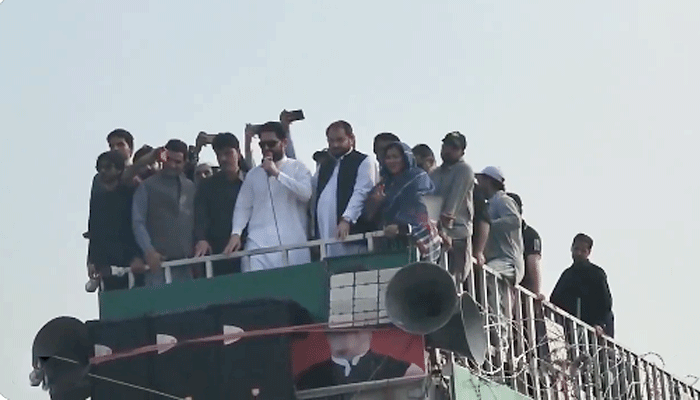
When the long march began on October 4, the large
turnout expected from Punjab failed to materialize. A Hiace van carrying
workers from Mianwali and a few participants from Faisalabad joined the convoy.
As the convoy traveled from Lakki Marwat to Karak and then to Lachi, workers
from Karak returned home. By the time the convoy reached Matni, an area of
Peshawar, the number of participants from other districts had also declined.
Workers who had joined from Kohat returned home as the convoy prepared to head
toward Khyber district. Speaking to V News in Matni, Ammar Ali, a PTI
supporter from Faisalabad, said workers in Punjab feared arrest if they took
part in political protests. For this reason, they had decided to travel to
Lakki Marwat and join the long march rather than stage protests in Punjab.
According to Ali, only around 20 to 22 people
from across Punjab were part of the convoy at that point. These included four
friends traveling together and a vehicle carrying participants from Mianwali. Ali
said he had expected large numbers of workers from Punjab’s districts bordering
Khyber Pakhtunkhwa, particularly Attock and Mianwali, as well as from southern
Punjab, including Dera Ghazi Khan and Rahim Yar Khan, to join the march.
However, that did not happen. As a result, the long march launched to secure
Imran Khan’s release remains, at least for now, largely dependent on the
activities of the Khyber Pakhtunkhwa provincial government and its supporters.
With the expected political and public backing from Punjab and other provinces
failing to materialize, the plan to take the march all the way to Islamabad
remains a major question.