Pakistan Tehreek-e-Insaf (PTI) Peshawar district
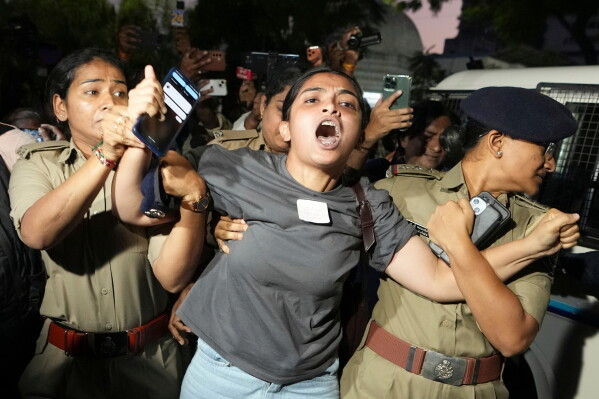
president Irfan Saleem has called for a protest in Peshawar on Monday, October
12, against the imposition of governor’s rule and an emergency in the province.
According to a statement issued by the party, the protest will be held at 12
noon on GT Road in Hashtnagri, Peshawar. The statement said the demonstration would be
held against the reported arrests of Khyber Pakhtunkhwa Chief Minister Sohail
Khan Afridi, PTI provincial president Junaid Akbar Khan, Khyber Pakhtunkhwa
Assembly Speaker Babar Saleem Swati, and other party leaders and workers.
However, the authorities have not yet confirmed these arrests.
Irfan Saleem appealed to the people of Peshawar,
party workers, organisational office-bearers, parliamentarians, and party
ticket-holders to participate in the protest in large numbers. He said the
demonstration would remain peaceful and was intended to raise a voice against
governor’s rule, the imposition of emergency measures, and action taken against
the party leadership. The statement was issued by PTI’s Peshawar district
organisation.
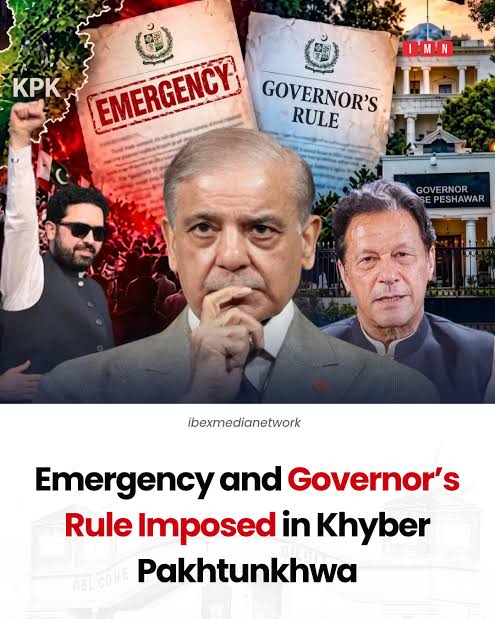
President Asif Ali Zardari Approves Governor’s
Rule and Emergency in 12 Districts
President Asif Ali Zardari has imposed
governor’s rule in Khyber Pakhtunkhwa and declared an emergency in 12 districts
of the province on the recommendation of the federal cabinet. The
decision was taken after Khyber Pakhtunkhwa Governor Faisal Karim Kundi submitted
a report on the prevailing situation. As a result, the powers of the elected
provincial government have been transferred to the governor. Faisal Karim Kundi
will administer the province through an interim cabinet. This marks the fourth
time governor’s rule has been imposed in Khyber Pakhtunkhwa. The current
situation is different from previous instances because an emergency has also
been declared in 12 districts under Article 232 of the Constitution of
Pakistan.
Governor’s rule was previously imposed in the
province in 1975, 1994, and 1999. The historical background of these measures
includes political tensions, disagreements between the federal and provincial
governments, and changes in government. The latest decision has sparked debate
over the federal government’s administrative role in the province, the powers
of the elected provincial government, and the prevailing law-and-order
situation.
First Imposition of Governor’s Rule in 1975
Governor’s rule was first imposed in Khyber
Pakhtunkhwa in 1975, when the federal government led by Prime Minister Zulfikar
Ali Bhutto decided to impose emergency measures in the province. At the time,
Hayat Muhammad Khan Sherpao, a prominent leader of the National Awami Party
(NAP), was killed in a bomb blast while delivering a speech at the history
department of the University of Peshawar. The incident intensified political
tensions in the province. The National Awami Party was subsequently banned, and
arrests were made. The events of that period had a profound impact on
provincial politics and relations with the federal government.
Second Instance in 1994
Governor’s rule was imposed for the second time
in 1994, amid political tensions between the federal government led by Prime
Minister Benazir Bhutto and the Pakistan Muslim League-Nawaz (PML-N) provincial
government in Khyber Pakhtunkhwa. Pir Sabir Shah was the chief minister at the
time. According to the historical account provided, political manoeuvring
against the provincial government involved the absence of assembly members and
developments surrounding a no-confidence motion. Aftab Ahmad Khan Sherpao
subsequently formed the provincial government.
Third Instance in 1999
The third imposition of governor’s rule occurred
in 1999, when General Pervez Musharraf overthrew the PML-N federal government
in a military coup. Changes were subsequently made to the provincial
administrative structure. Mian Gul Aurangzeb, who was associated with the
PML-N, was removed as governor and replaced by Lieutenant General (retd.)
Muhammad Shafiq, who was assigned provincial administrative responsibilities. Lieutenant
General (retd.) Syed Iftikhar Hussain was later appointed governor of the
province. He administered provincial affairs with a cabinet of his own until a
Muttahida Majlis-e-Amal (MMA) government was formed in November and December
2002. The previous period of governor’s rule thus ended with the establishment
of an elected provincial government.
Fourth Imposition of Governor’s Rule
Governor’s rule has now been imposed for the
fourth time, suspending the government led by Pakistan Tehreek-e-Insaf Chief
Minister Muhammad Sohail Afridi. Governor Faisal Karim Kundi will run the
province with the assistance of an interim cabinet. The decision represents a
major change in the provincial administration and the distribution of executive
powers, and has prompted political opposition to the move.
Emergency Declared in 12 Districts Under Article
232
Alongside governor’s rule, an emergency has been
declared in 12 districts of Khyber Pakhtunkhwa under Article 232 of the
Constitution of Pakistan. The districts include eight areas that were formerly
part of the Federally Administered Tribal Areas (FATA): Khyber, Mohmand,
Kurram, Orakzai, Bajaur, North Waziristan, Upper South Waziristan, and Lower
South Waziristan. Four additional southern districts—Dera Ismail Khan, Tank,
Bannu, and Lakki Marwat—have also been included in the emergency measures. Under
the administrative arrangement, the emergency will apply fully in the Bannu and
Dera Ismail Khan Divisions, while its implementation will be partial in the
Peshawar, Kohat, and Malakand divisions. The Hazara and Mardan divisions have
been exempted. Consequently, the scope of emergency measures will vary across
different parts of the province.
The imposition of governor’s rule in Khyber
Pakhtunkhwa and the declaration of an emergency in 12 districts mark a
significant change in the province’s administrative structure. The
constitutional, political, and administrative implications of the decision are
expected to become clearer in the coming days. The law-and-order situation, the
powers of the elected provincial government, and relations between the federal
and provincial governments are likely to remain central issues in the debate
surrounding the decision.