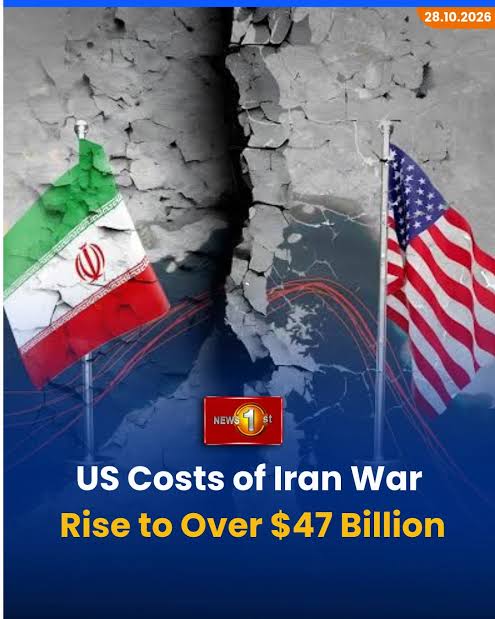
The United States’ spending on military
operations against Iran has exceeded $47 billion, according to Pentagon
figures. The amount is 25 percent higher than the Defense Department’s estimate
in July. US Defense Secretary Pete Hegseth put the cost of the war against Iran
at $37.5 billion in July. The latest figure exceeding $47 billion highlights a
significant increase in the financial burden of the conflict.
The rising cost of the war comes as the
Republican Party faces political repercussions ahead of the November 3 midterm
elections. The elections will determine the balance of power in the US Congress
for the next two years. The war with Iran and rising global energy prices has
affected public support for Republican candidates. The party currently holds
narrow majorities in both chambers of Congress.
How Much Will It Cost to Replenish Weapons
Stockpiles?
According to British news agency Reuters, the
Pentagon’s latest estimate covers the costs of military operations. However,
replenishing weapons and ammunition used during the war will require more than
$29 billion. In addition, more than $6 billion is expected to be needed to
replace military equipment and platforms destroyed during the conflict,
including aircraft and a large number of drones. The Pentagon has not yet
publicly released its latest estimate and did not immediately respond to
Reuters’ request for comment.
Prolonged War Challenges US Strategy
President Donald Trump launched the war against
Iran in February in coordination with Israel, initially expressing the
expectation that the conflict would not last long. The initial US strategy
involved targeting Iran’s defense systems with expensive, advanced missiles,
with the aim of subsequently relying on comparatively cheaper weapons. These
included Joint Direct Attack Munition (JDAM) guided bombs used in airstrikes, of
which the United States maintains large stockpiles.
The ceasefire reached in April gave Iran an
opportunity to clear debris from underground storage facilities and restore
some of the defense systems, missiles and drones stored there to operational
use. These assets had previously become inaccessible following US attacks. Trump
subsequently imposed a naval blockade in the Strait of Hormuz to restrict
Iran’s oil export revenues. He has also indicated the possibility of resuming
military operations against Iran after the midterm elections. US officials told
Reuters, speaking on condition of anonymity, that the Pentagon would resume
large-scale military operations against Iran if ordered to do so.