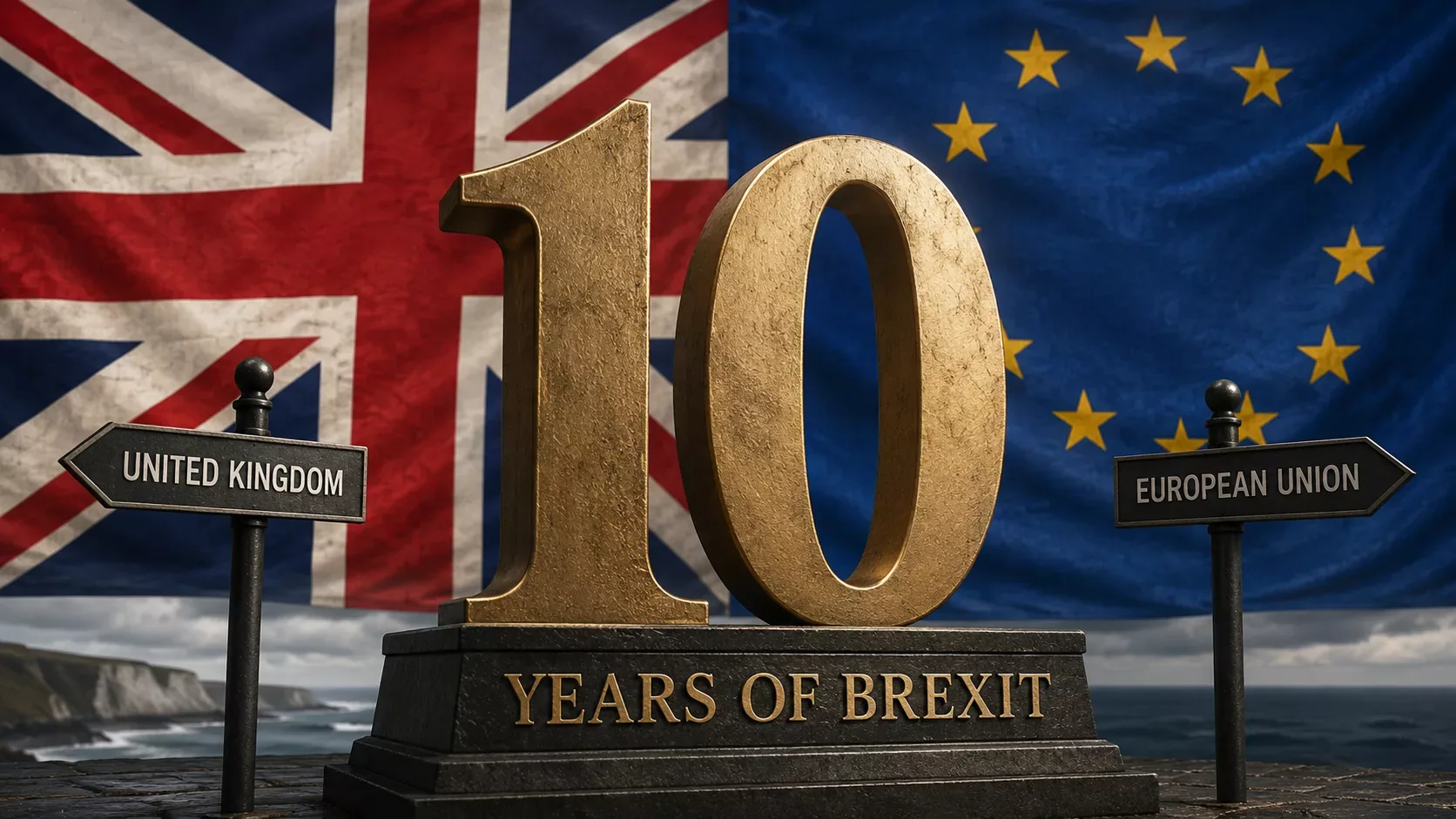
A decade after the United Kingdom’s formal
withdrawal from the European Union, a growing consensus has emerged among
British political and economic circles that the decision to leave the bloc —
intended to secure full control over the country’s borders and curb immigration
— has caused significant economic and administrative damage rather than
delivering the promised benefits. Recent statements by British Prime Minister
Andy Burnham have brought official recognition to the argument that, over the
past ten years, Britain has lost the effective control over its borders that it
enjoyed as a member of the European Union.
The main reason behind this U-turn is the
fundamental disruption of the immigration system. Before Brexit, labour
migration from the European Union to Britain was largely temporary or seasonal,
with workers returning to their home countries after completing their jobs.
This pattern was often described as a “revolving door.” However, after Brexit
restricted the arrival of European workers, a new visa system was introduced to
support the British economy. As a result, millions of people from India,
Nigeria and other non-European regions began settling in Britain on a long-term
basis, often bringing their families with them. Net migration consequently
reached a record high of 944,000 by March 2023.
At the same time, a serious crisis involving
small boats crossing the English Channel developed. After leaving the European
Union, Britain lost access to the historical Dublin arrangements for returning
migrants, under which people entering the country irregularly could, under
certain conditions, be sent back to France or other European countries. In
addition, the British economy has faced trade barriers, administrative
paperwork and severe labour shortages in the National Health Service (NHS), the
hotel industry, agriculture and logistics. These pressures have ultimately
forced London to reconsider its relationship with Brussels.
Restoring Free Movement and Its Practical
Framework
If an agreement restoring free movement between
Britain and the European Union were introduced, it could fundamentally change
the rights of citizens in both regions concerning employment, travel and legal
residence. Such an arrangement could replace the current restrictive
points-based immigration system with a framework based on reciprocal rights
associated with the European single market.
Rights of British Citizens
The strict 90-day limit on stays in the European
Schengen Area would be lifted for British citizens. Holders of British
passports would be able to live, study and work in all 27 EU member states
without needing advance visas, employer sponsorship or electronic travel authorizations.
In addition, British citizens would regain access to reciprocal healthcare
arrangements across Europe through the European Health Insurance Card (EHIC).
They would also benefit from legal provisions allowing state pension
entitlements accumulated while working abroad to be coordinated across participating
countries.
Removal of Restrictions for European Citizens
On the other hand, the restrictions imposed on EU
citizens entering Britain after Brexit would be removed. European workers would
no longer have to meet the substantial annual salary threshold of £38,700
required under the Skilled Worker visa route, nor would they have to pay
thousands of pounds in visa fees and the Immigration Health Surcharge. EU
citizens would be able to travel directly to Britain to look for employment and
begin working without the existing immigration barriers.
Clearing Up Misconceptions about the Law
A common misconception is that free movement
gives every foreign national an unrestricted right to remain in another country
for life. In reality, under EU rules, anyone staying for more than three months
must generally be employed, self-employed, enrolled in formal education, or
financially self-sufficient and covered by comprehensive health insurance,
subject to the applicable legal conditions.
Proposals for a Youth Mobility Scheme and Faster
Work Permits
Because restoring full free movement is a complex
and lengthy process, work is reportedly progressing rapidly on a reciprocal Youth
Mobility Scheme as an initial transitional measure. Under the proposal
put forward by the European Commission, British and European young people aged
18 to 30 would be offered a simplified visa arrangement allowing them to
travel, study and work in each other’s countries.
Under the scheme, young people would be permitted
to live in the other country for two to three years to gain experience without
facing high salary thresholds or stringent employer-sponsorship requirements. The
initiative could provide immediate relief to British universities, scientific
and research institutions, and young workers. It could also help Britain’s
hospitality and services sectors recruit skilled young employees at a time of
labour shortages. The proposal is being viewed as a first concrete step towards
a broader economic and labour agreement in the future.
Political Obstacles, a Public Referendum and the
Road Ahead
Despite the potential economic and immigration
benefits, an immediate return to the European Union’s single market and free
movement would not be straightforward. British Prime Minister Andy Burnham has
made clear that he would not impose such a decision without seeking the
public’s direct opinion. This suggests that a new public referendum would be
necessary before free movement could be restored.
Furthermore, the red lines set out in the Labour
Party’s election manifesto do not permit a major change of this kind during the
current parliamentary term. As a result, formal legislation to restore full
free movement may not take shape until after the 2029 general election. Experts
believe that during this transitional period, Britain will gradually move
closer to Europe through sector-specific agreements, youth mobility
arrangements and mutual security protocols. The aim would be to help the
British economy overcome the effects of isolation after 2026 and reintegrate it
into the global mainstream.