Thousands of people took to the streets in
various Venezuelan cities to demand free elections and other political reforms.
It was the opposition’s first nationwide protest in nearly two years. U.S. President
Donald Trump and Acting President Delcy Rodríguez have announced plans to hold
elections, but no date has yet been set for voting to elect a new president to
replace former President Nicolás Maduro. Maduro was captured during a U.S.
military operation in January.
Opposition leader and Nobel Peace Prize laureate
María Corina Machado has said that elections should be held by July 2027. She
is currently outside the country after spending nearly a year in hiding
following the disputed 2024 presidential election. Machado’s political
movement, Vente Venezuela, organized demonstrations in several cities,
including the capital, Caracas, as well as Valencia, Maracay, San Cristóbal and
Maracaibo.
Eighteen-year-old cosmetology student Luismari
Hernández, who joined hundreds of protesters in northern Maracay, said, “It
makes me happy to see all this because I believe change is possible.” She said
she had faced difficult circumstances because of several problems, including
the rising value of the U.S. dollar and difficulties pursuing her education.
However, she said she remained hopeful about her country and its future leader
and president, María Corina Machado. Hernández added, “I have taken to the
streets to protest before, when conditions were much more difficult. Today, I
want to raise my voice, and I feel even less afraid than before.”
Since January 3, Delcy Rodríguez of the
long-ruling United Socialist Party of Venezuela (PSUV) has been governing the
country as interim president. The PSUV leadership has faced allegations of
human rights violations, arbitrary arrests, imprisonment and torture of
political opponents. Even after the U.S. military operation to capture and
detain former President Nicolás Maduro, the PSUV remained in power with support
from the White House.
Limited Presence of Government Security Forces
Venezuela’s socialist movement has been in power
since 1999, first under the late President Hugo Chávez and later under Maduro.
In the past, the government deployed security forces against protesters, but
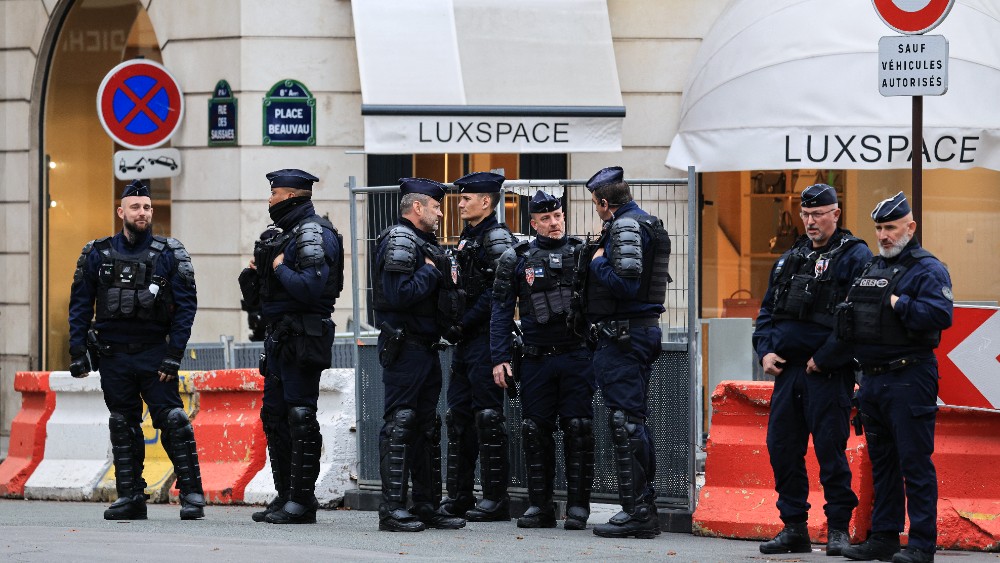
their presence at Thursday’s demonstrations was limited. Meanwhile, France has
deployed 70,000 police officers nationwide to prevent potential unrest and
looting during protests over rising living costs and deteriorating public
services. The military is also patrolling key locations in Paris.
According to Reuters, authorities have introduced
stringent security measures to protect shops, government buildings and security
personnel against possible attacks. Several shops in Paris have closed, while
major cultural attractions, including the Louvre Museum, the Musée d’Orsay and
the opera house, are also shut. More than 20 metro stations have suspended
services. Authorities have imposed bans or strict restrictions on
demonstrations in several cities amid fears of unrest. Last week, protests were
accompanied by widespread vandalism and looting.