Universities across the United Kingdom have begun
cancelling admission offers for international students from Pakistan,
Bangladesh, India and other countries amid rising visa refusal rates and
increasingly stringent Home Office regulations. According to an analysis by the
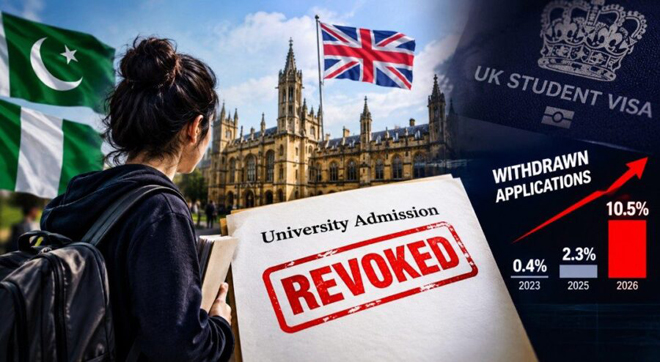
Financial Times, the withdrawal rate for UK student visa applications
reached 10.5% in the first half of 2026, compared with 2.3% in 2025 and just
0.4% in 2023. Universities have clarified that this decline is not primarily
the result of students voluntarily withdrawing their applications, but rather
of precautionary measures taken by institutions to protect their sponsorship
licences.
Pakistani students have been the hardest hit,
with the withdrawal rate for their applications surging to 40.9%, up from 3%
last year. Similarly, the rate for Bangladeshi students increased from 7.1% to
23.5%, for Nigerian students from 4.5% to 22.7%, and for Indian students from
1.2% to 5.2%. According to the report, approximately 15 British universities
have completely suspended admissions for students from Pakistan this year. Visa
processing data also indicate that refusal rates at nearly half of UK
universities have exceeded the prescribed threshold.
The primary cause of the crisis is the UK Home
Office’s stricter rules under the Basic Compliance Assessment (BCA). Effective
June 1, 2026, universities are required to keep their visa refusal rates below
5%, down from the previous threshold of 10%, while the required enrolment rate
has increased from 90% to 95%. Institutions that exceed the prescribed limits
risk losing their sponsorship licences. Under Home Office rules, if a
university withdraws a Confirmation of Acceptance for Studies (CAS) before a
final visa decision is made, the case does not count towards its visa refusal
rate. Consequently, universities are withdrawing student applications
themselves to avoid the risk of visa refusals damaging their compliance
records.
University leaders and education experts have
described visa officers’ decisions as unpredictable, unclear and controversial.
They argue that visas are being refused following interviews on minor or
irrelevant grounds, leaving universities with little choice but to cancel
admission offers. Education specialists have warned that institutions relying
heavily on international student tuition fees could face severe financial
difficulties, potentially leading to the closure of multiple courses and
thousands of job losses. The Home Office, meanwhile, maintains that although
international students are important to the UK, universities must exercise
greater responsibility when admitting students to preserve the integrity of the
immigration system.
The unprecedented crisis in Britain’s higher
education and immigration systems is not the result of a formal legal or
nationwide ban imposed by the British government on students from Pakistan,
India or Bangladesh. Rather, it stems from individual universities’
administrative decisions to protect their sponsorship licences. The main driver
is the Home Office’s stringent requirement that universities keep their visa
refusal rates below 5%, compared with the previous 10% threshold. Under the
rules, a formally refused student visa counts towards a university’s refusal
rate and may put its sponsorship licence at risk. However, if an institution
withdraws the student’s CAS before a final visa decision is issued, it can avoid
having that case recorded as a visa refusal. As a result, universities are
cancelling admissions on a large scale in advance to safeguard their ability to
recruit international students.
The stringent policy has dealt a particularly
severe blow to Pakistani students, whose application withdrawal rate has risen
dramatically from just 3% last year to 40.9%. Approximately 15 universities
have reportedly halted new admissions from Pakistan entirely. At the same time,
the consequences are proving potentially damaging for Britain’s own higher
education sector, where international student tuition fees are a major source
of institutional income. Education experts and vice-chancellors have warned
that the record decline in admissions from South Asia could leave dozens of
universities facing substantial financial deficits, the closure of academic
departments and campuses, and widespread redundancies among teaching and
administrative staff.