Security has been placed on high alert in
sensitive areas across South Africa following serious unrest and violent
incidents targeting foreign immigrants in the country’s economic and industrial
centers, particularly Johannesburg, including the Soweto area, and Durban. The
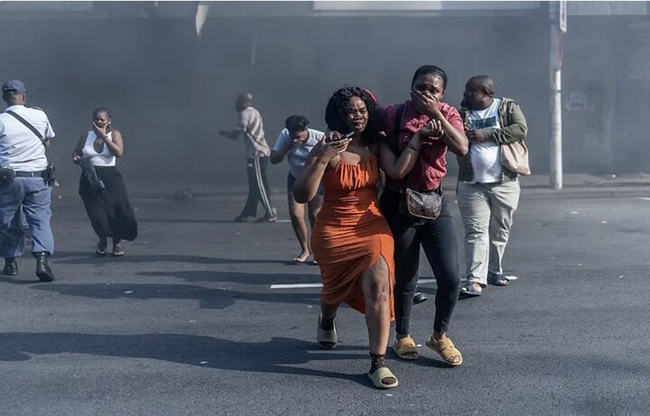
violent protests, which continued for a second consecutive day, saw groups of
angry local residents organize and target foreign nationals and their
businesses. Crowds set vehicles parked along roads on fire, broke into shops
and supermarkets owned by foreigners, and carried out widespread looting. They
also hurled bricks and glass bottles at police officers. Given the severity of
the situation, law enforcement agencies fired tear gas on a large scale and
used stun grenades to disperse the demonstrators.
The latest unrest was triggered by a
controversial policy directive issued by the Department of Home Affairs, which
was followed by the rapid spread of misinformation and rumours. South Africa’s
Constitutional Court had issued a ruling allowing asylum seekers to submit
applications upon entry into the country even without formal documentation.
Following the government directive intended to implement the court’s order,
hundreds of migrants gathered at refugee centres. Local groups opposed to
immigration exploited the issue, spreading rumours that the ruling African
National Congress (ANC) government planned to automatically grant legal status
and documentation to undocumented immigrants without any screening. This
misconception fuelled anger among local residents.
Local leaders and political representatives also
contributed to rising public resentment by openly opposing the government’s
move. Soweto community leader Sifiso Mposula alleged that the current
government had become excessively committed to protecting foreign nationals and
undocumented immigrants. Local councillor Mpumi Edward similarly argued that
the Department of Home Affairs’ decision to legalize the status of foreign
nationals was entirely wrong because, according to him, they had entered the
country illegally. He called for their immediate imprisonment rather than the
issuance of legal documents. In an emergency measure aimed at containing the
unrest and preventing further escalation, the Department of Home Affairs
formally withdrew the directive on Friday and announced that it would develop a
new, comprehensive plan in accordance with the Constitutional Court’s
requirements.
The violent incidents are not simply the result
of a sudden public reaction but represent a continuation of a broader,
organized anti-immigrant movement in South Africa, led by nationalist and
anti-immigration groups such as March and March. Previously, these groups had
issued an unofficial deadline of June 30 for foreign nationals to leave the
country. This created an atmosphere of fear and uncertainty, forcing tens of
thousands of migrants from other African countries to leave South Africa.
Although the government announced stricter border surveillance, a crackdown on
human-trafficking networks, and accelerated deportations of undocumented
individuals deemed ineligible to remain in the country in June, tensions have
persisted on the ground.
As Africa’s largest and wealthiest economic
centre, South Africa has attracted migrants seeking employment and better
living conditions for decades. However, over the past two decades, waves of
xenophobic attacks and violence against foreign nationals have periodically
resurfaced. The country’s unemployment rate has now exceeded 30 percent, and
some local residents claim that foreign nationals are taking away scarce
economic resources, jobs, and business opportunities. With municipal elections
scheduled for November 4 approaching, illegal immigration is increasingly being
used as an issue in electoral politics and as a means of mobilizing voters.
This has heightened concerns about the safety of foreign nationals, their
property, and their livelihoods.